Geithner to formally unveil details of next step in rescuing banks: Public-private partnerships. Treasury to put up $75 billion to $100 billion.
WASHINGTON -- The Obama administration on Monday will formally unveil a program to help banks clean up their books by subsidizing private investors' purchase of troubled assets.
The effort marks the next big step in Washington's six-month-old bank rescue, which has so far mostly entailed making capital investments and backstopping bank debt.
Administration officials, in a briefing with reporters late Sunday night, said they plan to commit $75 billion to $100 billion to start wiping out bad assets and would evaluate how programs are working before deciding how to commit more money.
The goal is to buy up at least $500 billion of bad assets -- loans, such as those for subprime mortgages, that are now in danger of default.
Investors have been waiting expectantly for details since last month when Treasury Secretary Tim Geithner announced the framework of a plan to address two of the biggest problems in the banking sector: the toxic assets keeping banks from lending and the shortage of capital at major institutions.
Under the new Public Private Investment Program, taxpayer funds will be used to seed partnerships with private firms to buy up assets backed by mortgages and other loans.
The effort will involve the Federal Deposit Insurance Corp., Treasury Department and the Federal Reserve, senior Treasury officials said late Sunday night.
Setting the right price
A key issue for the program is putting a value on the assets. The market for them has largely dried up, making them hard to value and causing a standoff. Investors don't want to overpay for them, and banks don't want to lose money by selling them too cheaply.
The administration says it doesn't want government to get involved in setting prices. So it plans to run auctions between the banks selling the assets and the investors buying them. The goal is to allow the market to set the price, the officials said.
Under one part of the plan, Treasury would partner with private investors to buy a pool of troubled assets, providing up to 50% of the needed money. The FDIC could then leverage the buying power by as much as 6 times. The amount of leveraged help would be decided on a case-by-case basis, the administration officials said.
The administration officials said they've gotten support from private investors and banks who have been briefed about the program. But some analysts questioned whether the government's help would be enough to push investors and banks toward figuring out a price.
"My worry is that negotiations could be dragged out as banks might not be willing to sell at a price that investors, even with their inexpensive financing, are willing to pay," said Jaret Seiberg, policy analyst at Concept Capital's Washington Research Group.
In addition to setting up the new public-private partnerships, the government plans to expand a Federal Reserve program launched last week that aims to spur lending.
Under the program, called Term Asset-Backed Securities Loan Facility, the Fed effectively serves as a matchmaker, partnering buyers and sellers of newly issued, top-rated securities backed by student, small business, auto and credit card loans.
The administration officials on Sunday said TALF has raised $9 billion in new securitizations, more than in the last four months combined.
Now they're expanding it to some lower-rated mortgage-backed securities.
"We do know that banks have these so-called toxic assets on their balance sheets," Christina Romer, chairwoman of the White House Council of Economic Advisers, said Sunday on CNN's "State of the Union."
"They are making banks unwilling to lend, they're making private investors unwilling to come into banks," Romer said. "We need to get those off the banks' balance sheets."
Getting private sector involved
An expanded use of public-private partnerships in the continuing bank bailout could accomplish two critical goals. They could successfully lure private capital into the process of rescuing troubled institutions, and they could enable market forces to set prices for hard-to-value assets.
But some critics say public-private partnerships won't do the trick -- that the administration must take more aggressive action such as seizing control of banks.
Another criticism of public-private partnerships: The government loans would pose too much risk to taxpayers.
"[I]f you think that the banks really, really have made lousy investments, this won't work at all; it will simply be a waste of taxpayer money," New York Times columnist Paul Krugman wrote Saturday on his blog.
The main concern: The government would be providing low-cost financing to buy the assets. And if the assets go bad, the government would be shouldering much of the loss. Because the money is cheap and downside risk is limited, private investors may be willing to pay too much for the toxic assets, increasing risk to taxpayers.
On Sunday night, the officials explained that they believe financing private investors to buy assets is a better option than nationalizing banks or simply ignoring banks and allowing the market alone to solve their problems.
In the end, the aim is to unfreeze the credit markets, which have been weighed down by consumer and investor fears about future losses at the nation's banks.
The financial crisis, considered the worst since the Great Depression, was sparked by a rapid decline of housing prices leading to high levels of mortgage defaults. Banks and other institutions that bet on those mortgages, often in the form of complex securities that packaged up slices of loans, have suffered huge losses in recent quarters.
Last fall, Congress and the Bush administration came together to pass an unprecedented $700 billion bailout plan, which has among other things pumped nearly $200 billion into hundreds of banks big and small.
President Obama and Geithner have been working for months, even before Obama took office in January, to fashion a comprehensive strategy for rescuing the banks.
Geithner's plans have been weighed down in recent days by congressional and public backlash against retention bonuses paid to employees of American International Group, a troubled insurer now majority owned by the government that has become a magnet for criticism.(CNNMoney.com)
Showing posts with label 2 U.S.. Show all posts
Showing posts with label 2 U.S.. Show all posts
Monday, March 23, 2009


Thursday, March 5, 2009
Clinton: 2 U.S. officials to visit Syria
JERUSALEM -- The U.S. government will dispatch two officials to the Syrian capital to explore Washington's relationship with Damascus, Secretary of State Hillary Clinton announced Tuesday. 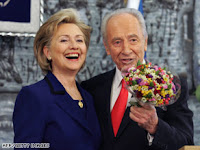 "There are a number of issues that we have between Syria and the United States, as well as the larger regional issues that Syria obviously poses," she said.
 "There are a number of issues that we have between Syria and the United States, as well as the larger regional issues that Syria obviously poses," she said.
Secretary of State Hillary Clinton meets with Israeli President Shimon Peres in Jerusalem on Tuesday.
She said the officials -- a representative from the White House and one from the State Department -- would explore "some of these bilateral issues."
"We have no way to predict what the future with our relations concerning Syria might be," she said.
"We don't engage in discussions for the sake of having a conversation. There has to be a purpose to them, there has to be some perceived benefit."
Clinton noted that members of the U.S. Congress have visited Damascus in recent weeks and months.
Last week, the State Department's top Middle East official, Jeffrey Feltman, met with the Syrian ambassador to the United States, marking a resumption of diplomatic dialogue after nearly five years.
The United States withdrew its ambassador from Syria four years ago, in protest of the assassination of former Lebanese Prime Minister Rafik Hariri.
Washington accuses Syria of being behind the killing of the popular statesman in a massive bombing in February 2005 that also left 22 others dead. Syria denies it, but an ongoing United Nations investigation found indications of Syrian involvement.
Clinton is in the Middle East on her second overseas trip as secretary of state, after a tour of Asia last month.
She said the officials -- a representative from the White House and one from the State Department -- would explore "some of these bilateral issues."
"We have no way to predict what the future with our relations concerning Syria might be," she said.
"We don't engage in discussions for the sake of having a conversation. There has to be a purpose to them, there has to be some perceived benefit."
Clinton noted that members of the U.S. Congress have visited Damascus in recent weeks and months.
Last week, the State Department's top Middle East official, Jeffrey Feltman, met with the Syrian ambassador to the United States, marking a resumption of diplomatic dialogue after nearly five years.
The United States withdrew its ambassador from Syria four years ago, in protest of the assassination of former Lebanese Prime Minister Rafik Hariri.
Washington accuses Syria of being behind the killing of the popular statesman in a massive bombing in February 2005 that also left
 22 others dead. Syria denies it, but an ongoing United Nations investigation found indications of Syrian involvement.
Clinton is in the Middle East on her second overseas trip as secretary of state, after a tour of Asia last month.
Clinton lays a wreath at the Yad Vashem memorial to Holocaust victims in Jerusalem on Tuesday.
She met with Israeli leaders on Tuesday, a day after pledging $900 million to help the Palestinians, and vowed to "do everything we can to ensure Israel's security now and into the future."
Clinton spoke at a joint news conference in Jerusalem with her Israeli counterpart, Foreign Minister Tzipi Livni, after their meeting, which included discussions about dealing with Hamas-controlled Gaza and Iran's nuclear program.
"We share Israel's concern about Iran's pursuit of nuclear weapons and its continued financing of terrorist organizations," Clinton said.
Israel has raised concerns about Iran's nuclear program, which the Islamic republic insists is only for peaceful purposes. Iran tested its first nuclear power plant last week using "dummy" fuel rods. Iranian officials said the next test will use enriched uranium, but it's not clear when the test will be held or when the facility will be fully operational.
The United States believes that Iran likely has enough material to make a nuclear weapon, Joint Chiefs of Staff Chairman Adm. Mike Mullen told CNN's John King on Sunday. Mullen's statement was rejected by Iran's Foreign Ministry as propaganda.
Earlier Tuesday, Clinton met with Israeli President Shimon Peres and repeated her warnings that rocket attacks from Gaza against Israel "must cease."
She planned to meet with Prime Minister-designate Benjamin Netanyahu, Defense Minister Ehud Barak and outgoing Prime Minister Ehud Olmert later in the day.
Clinton, accompanied by the U.S. special envoy on Mideast peace, George Mitchell, said it is a sensitive time as Israel tries to form a new government.
"The democratic process has its ups and downs," she told Peres, but "I want you to know that we will work with the government of Israel that represents the democratic will of the people of Israel."
When asked how the United States will deal with Netanyahu's opposition to an independent Palestinian state, Clinton said his view will be respected but noted that "the inevitability of working toward a two-state solution seems inescapable."
"That doesn't mean we don't respect the opinions of those who see it differently," she said. "We happen to believe that moving toward a two-state solution is in Israel's best interest."
Netanyahu is in the process of trying to include Israeli moderates in his government, which is currently dominated by his right-wing allies. Peres said a new government could be formed "quite soon."
Clinton will visit Palestinian leaders in the West Bank on Wednesday, including Palestinian Authority President Mahmoud Abbas and Prime Minister Salam Fayyad. Watch Clinton discuss Israel-Palestinian issues »
On Thursday, she'll head to Brussels, Belgium, for an informal meeting of NATO foreign ministers in preparation for the NATO summit in April. The next day, Clinton is scheduled to meet with Russian Foreign Minister Sergey Lavrov to begin a process that Vice President Joe Biden has called "pressing the reset button" in the U.S.-Russian relationship.
She then heads to Ankara, Turkey, for talks with key leaders before returning to the United States on Saturday.
State Department spokesman Robert Wood said Clinton's trip is an effort to "take the pulse of various leaders" on peace in the Middle East.
On Monday, Clinton attended a Gaza donors conference hosted by Egypt in the Red Sea resort city of Sharm el-Sheikh. She announced that the United States has pledged $900 million to help the Palestinian people and support the Palestinian government in the West Bank.
She said the U.S. pledge, which must be approved by Congress, has been "designed in coordination with the Palestinian Authority" to make sure the money "does not end up in the wrong hands" -- an apparent reference to the Hamas leadership in Gaza, which the United States has designated a terrorist organization. (CNN)
Subscribe to:
Posts (Atom)


 Posts

